
Peptide Storage
Peptide Storage – Best Practices for Stability and Integrity
To preserve the integrity of laboratory results, proper peptide storage is essential. Correct handling and storage practices can maintain peptide stability for extended periods while protecting against contamination, oxidation, and degradation that may compromise both the compound and your research outcomes. While some peptides are more sensitive than others, following proven storage guidelines can significantly extend their usability and reliability.
Temperature & Storage Conditions
Once peptides are received, they should be kept cold and protected from light at all times.
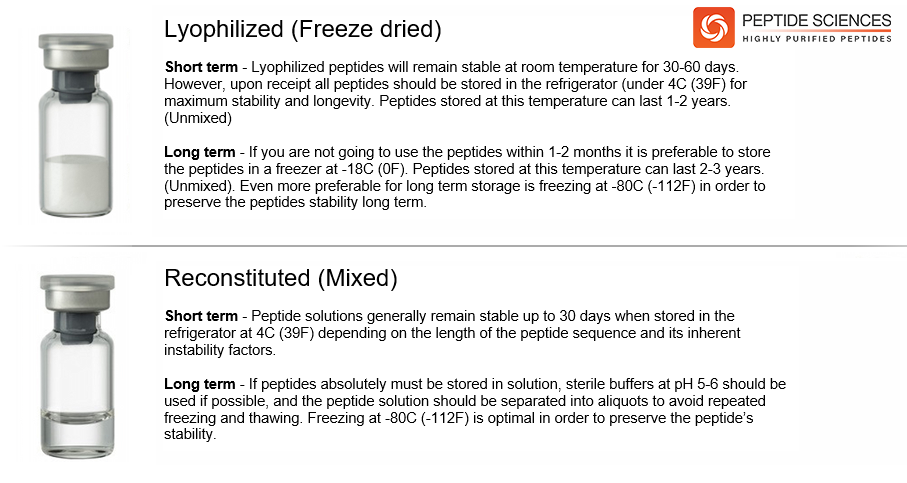
- For short-term use (days to weeks), peptides can be stored in a refrigerator at temperatures below 4°C (39°F).
- Lyophilized (freeze-dried) peptides are generally stable at room temperature for short periods (several weeks), provided they are kept in a dry, dark environment.
- For long-term storage (months to years), peptides should be stored in a freezer at approximately -80°C (-112°F) to maintain maximum stability and structural integrity.
Freezing is the preferred method for preserving peptides over extended periods. However, it is critical to avoid repeated freeze-thaw cycles, as this can accelerate degradation. Additionally, frost-free freezers should be avoided, since temperature fluctuations during defrost cycles can negatively impact peptide stability.
Preventing Oxidation & Moisture Contamination
Exposure to air and moisture is one of the primary causes of peptide degradation.
To minimize these risks:
- Allow peptides to reach room temperature before opening to prevent condensation inside the vial.
- Keep containers tightly sealed when not in use.
- Limit exposure to air by opening vials only when necessary.
- When possible, reseal containers under dry, inert gas (e.g., nitrogen or argon) to reduce oxidation.
Peptides containing amino acids such as cysteine (C), methionine (M), and tryptophan (W) are particularly sensitive to oxidation and require extra care.
A widely recommended practice is to aliquot peptides into smaller portions based on experimental needs. This reduces repeated exposure to air and eliminates unnecessary freeze-thaw cycles, helping preserve long-term stability.
Storing Peptides in Solution
Peptides stored in solution have a significantly shorter shelf life compared to lyophilized forms and are more susceptible to bacterial contamination and chemical instability.
- Whenever possible, peptides should be stored in their lyophilized state.
- If storage in solution is required, use sterile buffers at pH 5–6.
- Store solutions in aliquots to prevent repeated freezing and thawing.
- Refrigerated peptide solutions at 4°C (39°F) are generally stable for up to 30 days, although some peptides may degrade more quickly.
Peptides containing Cys, Met, Trp, Asp, Gln, and N-terminal Glu tend to be less stable in solution and should be handled with extra caution.
Choosing the Right Storage Containers
Proper storage containers play an important role in maintaining peptide quality.
- Containers should be clean, chemically resistant, and appropriately sized.
- Glass vials are often preferred due to their durability and chemical stability.
- Plastic vials (polystyrene or polypropylene) are commonly used, with polypropylene offering better chemical resistance.
While peptides may be shipped in plastic containers for safety, they can be transferred to high-quality glass vials if needed for long-term storage.
General Peptide Storage Guidelines
To ensure optimal peptide stability, always follow these key practices:
- Store peptides in a cold, dry, and dark environment
- Avoid repeated freeze-thaw cycles
- Minimize exposure to air and moisture
- Protect peptides from light exposure
- Avoid storing peptides in solution for extended periods
- Aliquot peptides according to experimental requirements
By following these best practices, researchers can significantly extend the stability, purity, and effectiveness of peptides, ensuring consistent and reliable results in all research applications.